Chronic Low Back Pain
Moving Beyond Pain Relief to Understanding the Root Cause
“Will I be able to play sports again?”
“Will I be able to lift and carry my child without worrying about my back pain returning?”
“Do I really need another surgery?”
These are questions I hear regularly from patients suffering from chronic low back pain.
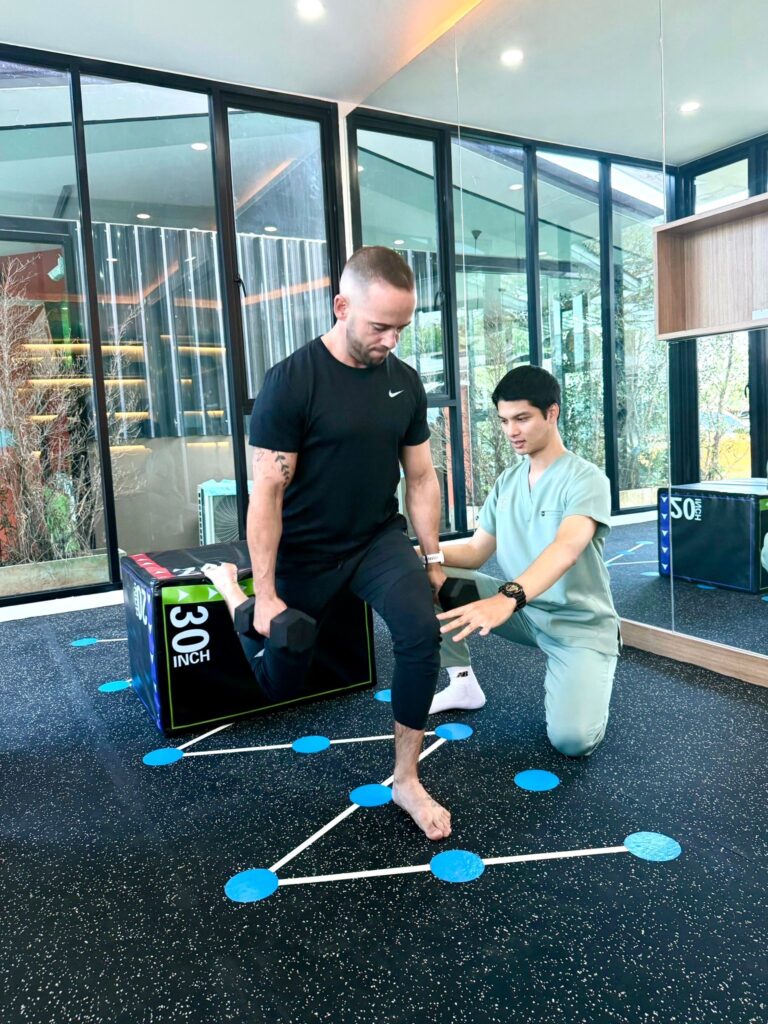
My name is Aof, a Physiotherapist.
Throughout my 10 years of clinical experience, I have had the opportunity to work with a wide range of musculoskeletal and neurological conditions. During my 5 years at Bangkok Hospital Phuket, one of the largest hospitals in Southern Thailand, I treated many patients with spinal conditions, including those who required surgery and post-operative rehabilitation.
Working in a hospital environment allowed me to see both sides of spinal care from acute injuries to complex cases requiring surgical intervention and long-term rehabilitation.
However, one thing became increasingly clear to me:
Surgery can be the right solution for certain patients, but it is not the solution for everyone.
Many patients recover well immediately after surgery. However, some experience recurring symptoms months or years later, and some may eventually require additional procedures.
This led me to ask an important question:
“Are we truly addressing the root cause of the problem, or are we only treating the final consequence?”
From Treating Symptoms to Understanding the Root Cause
After leaving the hospital and transitioning into private clinical practice, I began working with a larger number of patients suffering from chronic pain.
These included:
▪ Chronic low back pain
▪ Neck and shoulder pain
▪ Work-related injuries
▪ Sports injuries
▪ Persistent pain despite previous treatments
Through continuous professional development, clinical education, and reviewing current scientific evidence, my approach to treatment evolved.

Instead of focusing only on reducing pain, I started focusing on a more important question:
“Why did this problem develop in the first place?”
Pain is often only a warning signal. The underlying causes may involve multiple factors, including:
▪ Reduced muscle strength
▪ Poor muscular endurance
▪ Inefficient movement patterns
▪ Impaired neuromuscular control
▪ Lifestyle factors
▪ Fear of movement after previous injuries
Therefore, effective rehabilitation should not only aim to decrease pain but also restore the body’s ability to move, perform, and adapt again.
Personalized Exercise Programs: Not Just Doing Exercises, But Doing the Right Exercises for You
One of the main approaches I use is individualized exercise rehabilitation.
I believe that:
There is no single exercise program that works for everyone.
Every person has a different body, lifestyle, history, and goal.
Some patients may need to improve core strength and spinal stability.
Some may need better movement control.
Others may need to rebuild strength and endurance to return to sports or daily activities.
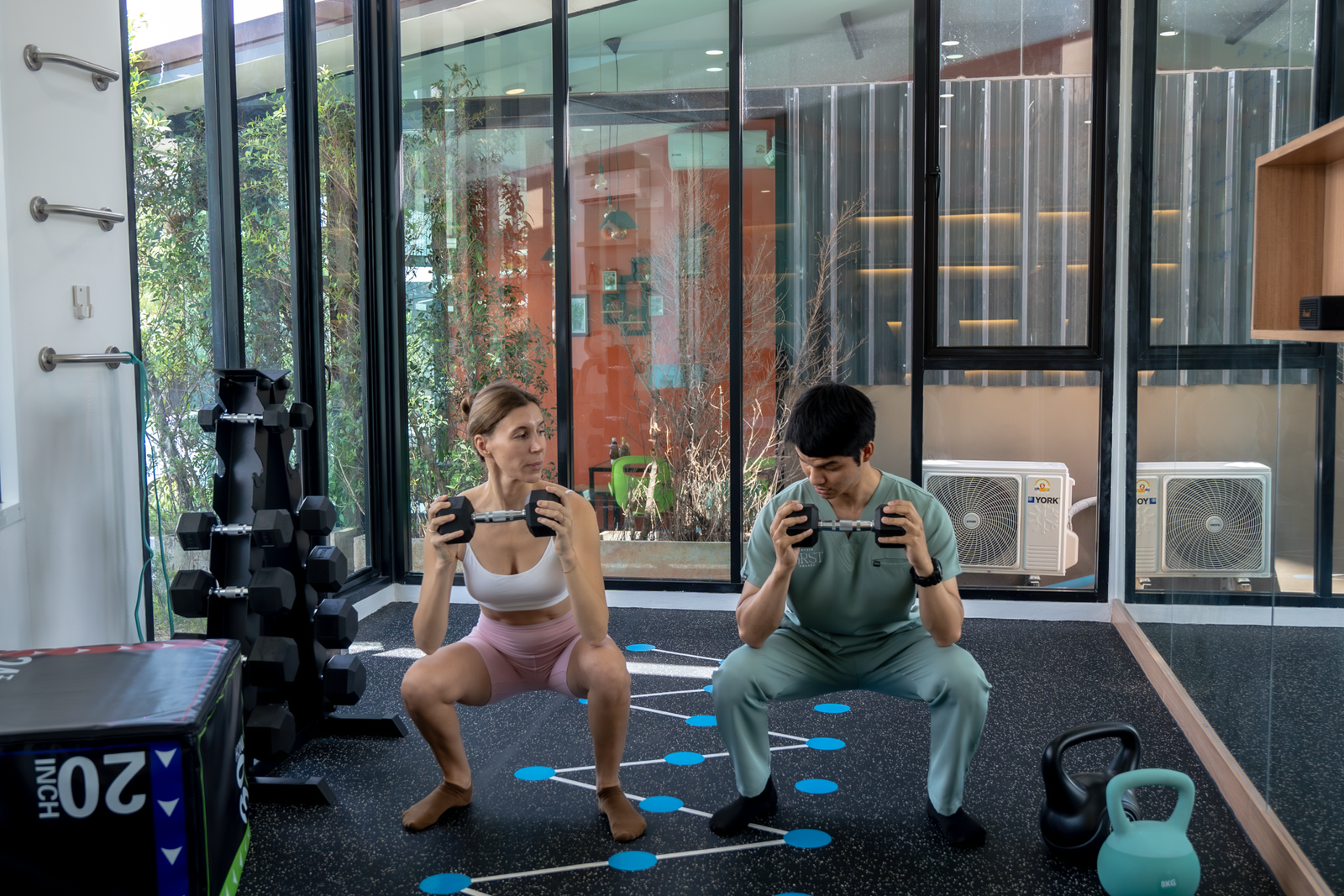
When we understand the true cause of the problem and design a program specifically for that individual, the results can be significantly different.
Many of my patients have been able to return to the activities they love:
▪ Playing sports again
▪ Exercising with confidence
▪ Carrying their children without fear
▪ Enjoying daily activities with less limitation
The goal is not simply to remove pain.
The goal is to help patients regain confidence and control over their own body.
The Human Body Is More Than Just Muscles and Joints
After more than 10 years in clinical practice, one of the most important lessons I have learned is:
There is no “best treatment method” without first understanding the individual patient.
The human body does not function through the muscular system alone.
The nervous system, pain sensitivity, previous experiences, stress, movement habits, and personal goals can all influence recovery.
That is why every treatment plan should begin with:
▪ A detailed history assessment
▪ A comprehensive physical examination
▪ Identifying the main contributing factors
▪ Creating a rehabilitation plan that matches the patient’s goals
Because good treatment is not only about knowing:
“What should we do?”
It is about understanding:
“Why are we doing it, and how can we make it appropriate for this specific person?”
My Current Approach to Treatment
Currently, I work as a Physiotherapist at Physio First Phuket.
Over the years, my clinical focus has increasingly shifted toward managing patients with chronic pain conditions, particularly chronic low back pain.
Many of the patients I currently see at the clinic are individuals who have been experiencing back pain for months or even years. Some have tried multiple treatments before seeking further help, while others have adapted their lifestyle around their pain avoiding certain movements, reducing physical activities, or feeling uncertain about whether they can return to the things they enjoy.
My approach focuses not only on reducing pain, but also on understanding the contributing factors behind each individual’s condition and developing a rehabilitation plan that helps them regain confidence, strength, and function.
My treatment approach focuses on combining:
1. Musculoskeletal Rehabilitation
Using exercise-based rehabilitation to improve:
▪ Muscle strength
▪ Endurance
▪ Flexibility
▪ Movement quality
▪ Functional performance
The goal is not simply to make patients feel better temporarily, but to help the body become more capable, resilient, and prepared for daily activities and personal goals.
2. Neuromuscular Rehabilitation
For some chronic pain conditions, the nervous system can play an important role in pain perception, movement control, and muscle function.
In selected cases, acupuncture may be incorporated as part of a comprehensive rehabilitation approach to help modulate nervous system activity and support recovery, together with exercise-based treatment.
Rehabilitation Is Not Only About the Final Result, It Is About the Journey!! The difference in my approach is not only focusing on the final goal:
“How can we reduce your pain?”
But also: “Are we moving in the right direction throughout the recovery process?” Patients should understand what is happening in their body.
They should understand why they are performing specific exercises.They should feel confident and involved in their own recovery. Because ultimately:
A physiotherapist is not only someone who treats pain. A physiotherapist helps people return to the life they want to live.
If you are experiencing chronic low back pain, recurring symptoms, or difficulty returning to the activities you enjoy, the most important first step may not be asking:
“What treatment do I need?”Instead, ask:
“What is my body trying to tell me, and where is the true source of the problem?”
Aof | Physiotherapist
Physio First Phuket
Evidence Behind my Approach
My approach is based on current scientific evidence showing that chronic low back pain is a complex condition influenced by physical, neurological, psychological, and lifestyle factors.
Current guidelines recommend individualized, exercise-based rehabilitation combined with patient education and self-management strategies rather than focusing only on pain relief or structural findings.
Selected references
1. World Health Organization. WHO guideline for non-surgical management of chronic primary low back pain. 2023.
2. Hayden JA, Ellis J, Ogilvie R, et al. Exercise therapy for chronic low back pain. Cochrane Database of Systematic Reviews. 2021;9(9):CD009790.
3. Foster NE, Anema JR, Cherkin D, et al. Prevention and treatment of low back pain: evidence, challenges, and promising directions. Lancet. 2018;391(10137):2368-2383.
4. O’Sullivan PB, Caneiro JP, O’Keeffe M, et al. Cognitive Functional Therapy for disabling low back pain: a randomised controlled trial. Lancet. 2018;391(10137):2377-2386.
5. Hodges PW, Tucker K. Moving differently in pain: a new theory to explain the adaptation to pain. Pain. 2011;152(3 Suppl):S90-S98.
6. Weinstein JN, Tosteson TD, Lurie JD, et al. Surgical versus nonoperative treatment for lumbar disk herniation: four-year results for the SPORT trial. Spine. 2008;33(25):2789-2800.
7. Traeger AC, Hübscher M, Henschke N, et al. Psychological therapies for chronic low back pain. Cochrane Database of Systematic Reviews. 2017.
8. Steiger F, Wirth B, de Bruin ED, Mannion AF. Is a positive clinical outcome after exercise therapy for chronic non-specific low back pain contingent upon a specific exercise intervention? A systematic review and meta-analysis. European Spine Journal. 2012;21(6):1307-1320.
9. Lin CW, Haas M, Maher CG, Machado LA, van Tulder MW. Cost-effectiveness of guideline-endorsed treatments for low back pain: a systematic review. European Spine Journal. 2011;20(7):1024-1038.
10. Jacobs WCH, van Tulder M, Arts M, et al. Surgery versus conservative management of sciatica due to a lumbar herniated disc: a systematic review. European Spine Journal. 2011;20(4):513-522.